Insights < BACK TO ALL INSIGHTS

Prediction Markets at a Crossroads: Licensing, Compliance, and Future(s)
Prediction Markets at a Crossroads: Licensing, Compliance, and Future(s)
By: Kyra Pulliam
Last week I had the honor of attending the inaugural PREDICT Conference hosted by DealFlow Events in New York City. This event should not be confused with the NEXTPredict Summit, taking place October 22-23, or Predict 2026, scheduled for December 7-9, both of which will also be held in New York.
If the growing number of prediction market conferences borders on excessive, it is easy to understand why: Prediction markets are the current hot topic as a novel industry with the potential to generate revenues rivaling, if not exceeding, traditional i-gaming products.
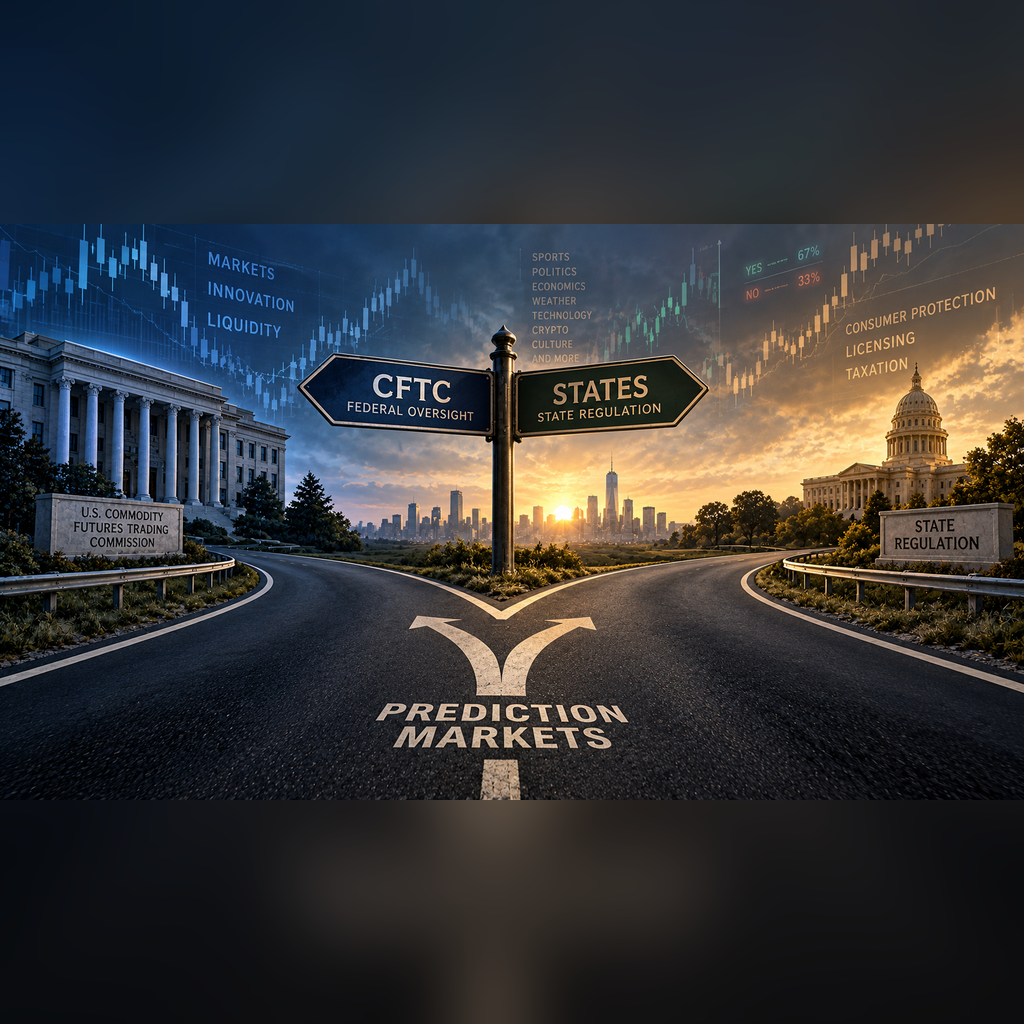
Of course, that potential all depends on which way the legal winds blow. Much of the current discourse focuses on whether the Supreme Court will grant certiorari in one or both of the two cases in which petitions for review have been filed following conflicting decisions in the lower courts on the question of who has the authority to regulate sports contracts.
Even with legal authorities and regulators among the panelists at these conferences, attendees should not expect definitive forecasts on how the Supreme Court will rule if the justices choose to review these cases. Even prediction markets are steering clear of contracts on whether the Supreme Court will side with the Commodity Futures Trading Commission (“CFTC”) or the states. However, users outside the United States can trade contracts on Polymarket predicting whether the Court will agree to hear a case by specific dates, reflecting the widespread expectation that the Court will eventually take up the issue (Kalshi has opted to not offer markets on its own pending litigation).
So if the experts are wary of offering projections on the biggest legal question concerning the future of prediction markets in the United States, what can be gained from these conferences? Are the networking opportunities worth the price tag if the industry’s longevity is uncertain? I’m here with my biggest takeaways from a licensing and compliance perspective, starting with a fundamental point worth keeping in mind.
REMINDER: Sports contracts are not the be-all and end-all of event contracts.
The media coverage might have you convinced that the outcome of the upcoming court cases will determine the future of prediction markets. Let’s get the facts straight: sports are the largest single trading category on the two biggest platforms in the United States, and generally a major driver of traffic to exchange platforms. If the Supreme Court rules in favor of the states, the industry would likely face significant disruption. Regulators in 40 jurisdictions could potentially order the suspension of sports trades until they determined whether and how to adapt their regulatory systems.
Even in the jurisdictions that have legalized sports betting, there is no assurance that prediction markets will be readily welcomed and assimilated into the current ecosystem. Licensing categories in many jurisdictions will likely need to be revised through statutory amendments or the issuance of regulatory guidance to include exchange-style platforms[1], and tax rates would be subject to debate. Even in the most optimistic scenarios, these bureaucratic processes would take time. Those timelines could be further elongated by opposition from groups that have increasingly challenged prediction markets in recent years: traditional online and land-based operators, tribal gaming commissions, as well as legislators and members of the public morally opposed to increased access to what they consider online gaming.
If these groups proved persuasive, states that permit sports betting could effectively prohibit sports event contract trading by simply refusing to incorporate them into their regulatory frameworks. If a jurisdiction did make all the changes necessary to accept exchanges offering sports contracts, the platforms themselves would have to weigh the commercial benefits of offering sports contracts against the cost of acquiring registration at the federal level, licensing at the state level, and accepting new tax burdens.
However, the legal disputes that could reach the Supreme Court focus on whether sports contracts—and only sports contracts—fall within the scope of state gambling laws or are instead subject to the CFTC’s exclusive federal jurisdiction. They do not necessarily resolve the legal status of prediction markets more broadly. While sports contracts are currently the favored products among the largest operators in the United States, prediction markets offer a wide array of contracts in categories that have not faced significant legal challenges, such as economics, weather, technology, cryptocurrency, and popular culture. They have even successfully defended their right to offer certain political event contracts against legal challenges alleging violations of federal laws prohibiting election wagering. Although these non-sports event contracts have faced some legal challenges, with a handful still ongoing, they have been the focus of fewer attacks. The settled challenges concerning non-sports contracts have resulted in the CFTC standing strong on its claims of exclusive regulatory authority, with exception of specific types of event contracts.
At PREDICT, Seth Young, CEO of High Roller Technologies, observed that we are witnessing a generational shift in how gaming is consumed—and it is hard to disagree. The simplicity of the binary system[2] at the heart of event contract trading, combined with the variety of available markets, allow prediction platforms to appeal to a broad consumer base. That includes people who may not feel lucky enough to enjoy casino-style games or knowledgeable enough to participate in sports betting, but are drawn to the opportunity to trade on information, apply their expertise in areas beyond sports, and profit from informed predictions. In another panel, Jeanine Hightower-Sellitto, SVP/GM of DraftKings Predictions, offered insight into how one of the biggest names in sports betting is adapting to the shifting landscape, and leveraging it as an opportunity for growth. By offering access to products like financial instruments and cultural contracts—such as predicting who will be eliminated from Dancing with the Stars—DraftKings is aiming to widen their reach and appeal to more women.
In short, while the Supreme Court might have the prediction market industry waiting with bated breath for a decision on sports contracts, the outcome could have significant implications for a valuable vertical without necessarily dooming prediction markets more broadly. The message from PREDICT is that smartest and strongest players will be poised to adapt and pivot in a worst-case scenario, and they are preparing to continue growing their market share in the U.S. despite legal adversity.
What can the prediction market industry do in terms of regulatory compliance to prepare for the future?
The number of panels at PREDICT devoted to legal issues from different perspectives makes it clear that neither the exchanges nor their opponents are going away any time soon. So what should stakeholders—from the platforms themselves to their service providers—do to ensure the longevity of their business?
Proactive self-regulation is the name of the game. This should consist of a two-pronged approach: preparing for compliance both internally and externally. Externally, that begins with viewing the CFTC as a friend, and not a foe. While the battle between the CFTC and states continues, the CFTC is persistently asserting its position as the exclusive governing authority over exchange markets while extending a hand to industry stakeholders through a transparent rulemaking process that encourages those stakeholders’ input. The day after PREDICT ended, the CFTC announced a Notice of Proposed Rulemaking that seeks to provide additional market clarity by refining the definition of “swap” to explicitly include sports-, politics-, cultural-, and weather-related event contracts. If the implication that the CFTC intends to solidify their claims of federal regulatory primacy was not clear, Chairman Michael S. Selig came right out and said as much in the press release accompanying the NPRM:
“Americans use event contracts to hedge risks, speculate, and provide the public with information about the outcome of future events. These products are commodity derivatives squarely within the CFTC’s regulatory remit under the Commodity Exchange Act and are within the agency’s exclusive jurisdiction.”
While the proposal has not been published in the Federal Register at the time of writing, publication is expected any day now, which will initiate a 30-day public comment period during which comments can be submitted online or by mail. I strongly encourage stakeholders to take advantage of this opportunity and keep an eye out for future notices and public comment periods. This will allow them to help shape the regulatory framework that will govern the industry regardless of any foreseeable Supreme Court decision in the future. Future notices in the pipeline will address topics such as margining on contracts, the discrepancy between NFA and CFTC marketing rules for futures commission merchants (“FCMs”) and designated contract markets (“DCMs”), and rulemaking for payment processors.
Internal preparations take the form of more traditional methods of self-regulation. Over the course of 2026, there have been three incidents of alleged insider trading on prediction markets that have received major media attention, and one charge of market manipulation. As with all new systems, bad actors are learning how to exploit unfair advantages, traditional compliance tools are proving inadequate, and the need for clarity about what is prohibited is growing. Multiple panelists echoed the necessity of developing strong internal processes and policies that protect sensitive data, monitor and test system integrity, and establish a paper trail that can be followed if necessary. These measures can help protect the consumer and ultimately, the future of the business by building regulatory confidence.
What does the future of licensing prediction markets look like?
As the industry matures and regulators face increasing pressure to intervene, the question becomes how these internal safeguards will translate into formal oversight—and what role licensing will play in that process. PREDICT highlighted multiple factors that could shape licensing and be the subject of their own blog posts.
First, as already discussed, a Supreme Court decision that establishes that sports contracts are a form of gaming and therefore fall within the regulatory jurisdiction of the states, a two-tiered system of licensing could possibly emerge in which a platform needs to be licensed at the federal as well as by each individual state it would like, and is permitted to, do business in.
The second is an industry contraction after the current tide of new platform products subsides, and a handful of power players arise. In either this case or the former, optimistic but cautious investors could wait to acquire existing DCMs at strategic points and register as an introducing broker (“IB”) to enter the market quickly. The idea presents an interesting use case for IB registrations, and a chance for this registration category to recoup some of the relevance it recently lost.
Exploring how IB registrations could still be used to enter the prediction market space is just one example of how much remains to be seen as the industry evolves. With six years in the gaming industry, including experience on the marketing affiliate side, I have seen firsthand how changes in the regulatory landscape can affect businesses in unexpected ways. Now, as a Licensing & Compliance Specialist, I am interested in exploring what these changes could mean for prediction markets, from licensing requirements to the practical challenges platforms may face as the industry develops. With several prediction market conferences taking place over the next couple of months, I am excited to see what new perspectives, ideas, and potential solutions emerge as industry stakeholders continue to exchange insights and grapple with the questions shaping this space. In future posts, I hope to take a closer look at these developments, examining what they mean for the businesses operating in this space and what industry participants should be watching as prediction markets enter their next phase.
[1] Bear in mind that this is an analysis of a worst-case scenario, not a foregone conclusion. Before the clash between prediction markets and state regulators escalated to its current level, Prophet Exchange launched in New Jersey as a Caesars partner by applying for a state-level Casino Service Industry Enterprise license. The NJDGE did not see the need to revise their license categories at the time, but it remains to be seen whether that opinion will hold.
[2] For those new to event contracts: A traditional sports bet might let you wager $10 on the Ravens to win at odds of +150, meaning you would make $15 in profit and get your original $10 back if you’re right. A binary contract works more like buying a yes-or-no ticket: you pay 60₵ for a contract that pays $1 if the Ravens win, earning 40₵ in profit, but you lose the 60₵ if they lose. Unlike a traditional sports bet, you can often sell your contract to another trader before the game ends, potentially locking in a profit or cutting your losses before the final outcome is known.