Insights < BACK TO ALL INSIGHTS

Overrun and Overreach: the New Challenge to Grand Jury Subpoenas
Overrun and Overreach: the New Challenge to Grand Jury Subpoenas
By: James Trusty
Most criminal law practitioners are quite familiar with clients receiving grand jury subpoenas. There are rituals we go through to figure out whether it’s a “friendly” subpoena, i.e. just trying to get business records from the client to be used against some other target, or whether it’s the visible start of a potential criminal prosecution against the client. Because the legal standard to justify issuing a subpoena is so low, an outright fight against the prosecutor issuing the subpoena is extremely uphill. A motion to quash is only granted “if compliance would be unreasonable or oppressive.”[1]Until a couple of weeks ago, that framework usually translated into successful challenges only when the subpoena’s request was so broad in terms of substance and/or time range that simply gathering the responsive documents would cost the subpoena’s recipient a crushing amount of time and effort.
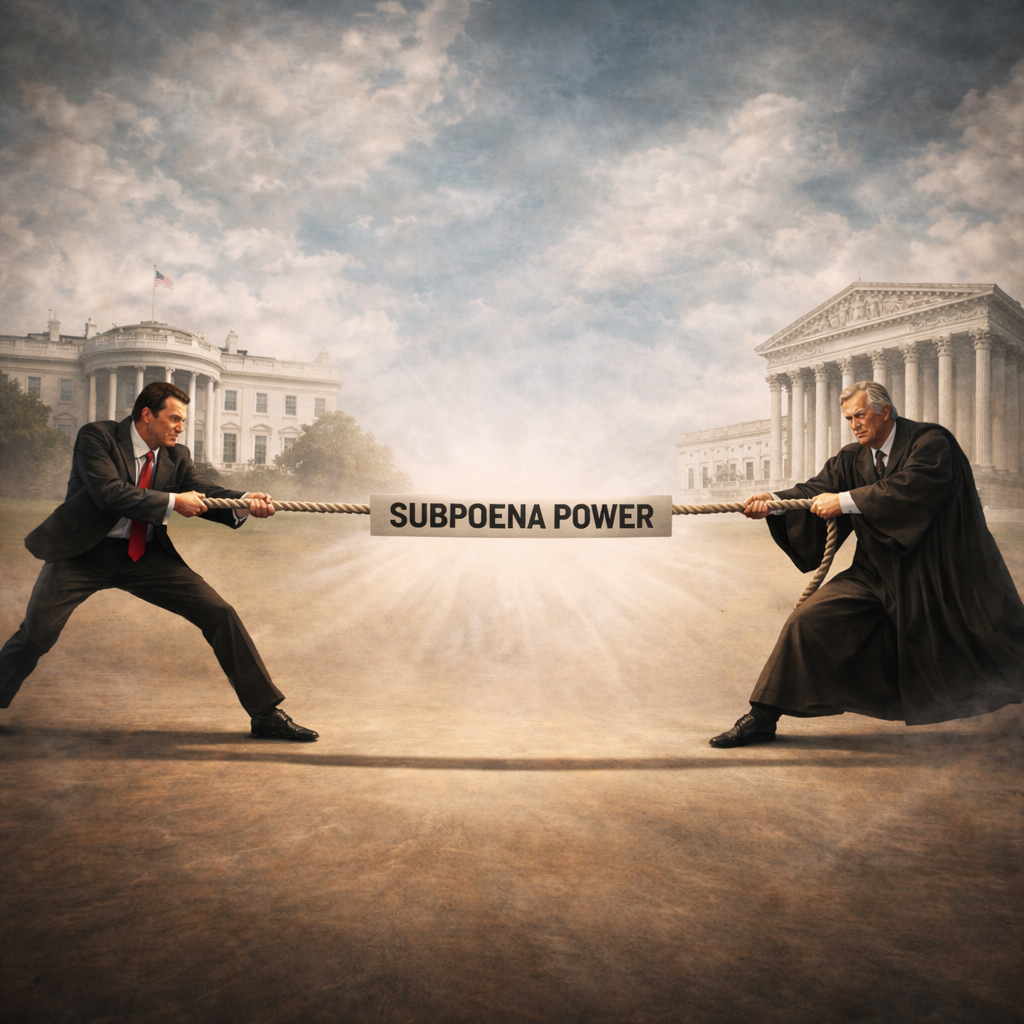
There is, however, a new subpoena sheriff in town. Chief Judge Boasberg of the United States District Court for the District of Columbia issued an opinion this month that purports to join a “unanimous chorus of sister circuits…[in establishing] that courts may quash subpoenas that the Government issued for an improper purpose.”[2] The subpoenas at issue were lobbed over from the U.S. Attorney’s Office in DC (“USAO”) to the Federal Reserve in reference to statements of Board Chairman Jerome Powell and huge cost overruns in the Fed’s refurbishing of its headquarters.
In staking out this new territory of judicial power over the executive branch, Judge Boasberg quotes innumerable social media postings from President Trump criticizing Chairman Powell. That part of the analysis cannot—and need not—draw any disagreement from the government. It’s the leap in logic that follows that is more debatable. The Judge writes, “Perhaps it comes as no surprise, then, that the D.C. U.S. Attorney’s Office has recently opened a criminal investigation into Powell.”[3] Even if we are to accept the newly-discovered power to quash investigative subpoenas due to “predominantly bad intentions,” how did Judge Boasberg pierce the Executive Branch veil to know that the U.S. Attorney’s Office is acting in bad faith? Judge Pirro is certainly loyal to President Trump, but does that automatically mean that the grand jury subpoenas were issued out of political expediency and not a genuine investigative interest? Judge Boasberg dipped into his own reservoir of political commentary to answer that question, asserting that “Trump has urged the [DOJ] to prosecute” adversaries, and the Department’s prosecutors have listened.[4] He points to prosecutions of James Comey, Adam Schiff, and Letitia James as evidence that Truth Social blasts lead to prosecutions. Is it possible that President Trump reasonably dislikes those three people and believes they have done criminal acts, and that some federal prosecutors happen to agree? Is it also not fair to suggest that prosecutorial decisions in the Eastern District of Virginia should not be held against prosecutors in Maryland or Washington, D.C.” For example, Trump-appointed U.S. Attorney Kelly Hayes (District of Maryland) brought the charges against Trump-nemesis John Bolton and no credible commentator would look at the search warrant affidavit and indictment and assign bad faith to Hayes or her assistants handling the case. So, the obvious limits to the judge’s “supporting evidence” suggests that the battle against President Trump might be joined a bit too eagerly by the DC bench. It took 19 pages for the judge to concede, “True, most of the evidence above speaks to the motives of the President, not the U.S. Attorney’s Office.”
Little weight is given to the fact that the USAO had “contacted the Federal Reserve on multiple occasions to discuss costs overruns and the Chairman’s congressional testimony, “but [informal efforts] were ignored, necessitating the use of legal process.”[5] Even after the subpoenas were served, the Fed Board chose not to comply, which led to the USAO’s Motion to Compel. Typically, avoidance to that degree greatly diminishes the impact of the subpoena’d party’s eventual claims of abuse.
The biggest question emanating from this case is whether it’s just another moment in creative jurisprudence because Pres. Trump is in the mix or whether it has some precedential value. Many defense attorneys would welcome a more interventionist approach to subpoena compliance, and good precedent could expand the ability to fight wrong-headed prosecutions long before an indictment surfaces.
But recent history suggests the willingness of D.C. judges to intervene against subpoenas may be directly related—consciously or unconsciously—to the political lane of the parties. There was no quashing or even suggestions of impropriety when Special Counsel Jack Smith trampled over attorney client privilege, executive privilege, and speech-and-debate clause immunity throughout the D.C. grand jury investigation of President Trump. Recent reports of Smith rummaging through years of phone records of Congressional GOP members and Kash Patel’s text messages have not seemed to spark any anger with the court—indeed, it was Chief Judge Boasberg who signed off on nondisclosure orders so the telecommunication companies could not warn lawmakers of Smith’s investigative drift net. Most recently, reports have surfaced about Smith’s FBI agents recording an attorney-client call between Susie Wiles and her attorney, with the parties disputing whether her attorney would have “consented” to a telephone sting operation at his client’s expense. The FBI claims the attorney (at obvious risk of disbarment and appropriate condemnation) agreed to surreptitiously record his client. The attorney, with the sizeable advantage of logic, says he never would have done such a thing to his own client. Either way, it is increasingly clear that Jack Smith’s investigation consistently bent and broke the rules in his quest to indict President Trump, and I can tell you first-hand that the federal bench in D.C. had no interest in assigning improper motivation to the use of objectively controversial subpoenas.
Criminal defense attorneys are left with a “wait and see” after Judge Boasberg’s groundbreaking decision. It seems likely that motions to quash will increase even though the subpoenas are given a presumption of regularity (meaning the defense has the burden of proving there is something wrong with them). How they will be treated is the key. And most fundamentally, is the Chief Judge signaling that the Executive Branch’s once-unfettered ability to investigate will—at least in some circumstances—be hamstrung by an aggressive Judiciary Branch? At best, this new balance of power should include an apolitical application to even be considered a potentially positive development. At worst, Judge Boasberg is linking judicial activism to political animus, and all of us may rue the day this djinni slipped out of the bottle.
[1] Fed. R. Crim. P. 17(c )(2).
[2] Board of Governors of the Federal Reserve System v. United States, Misc. Action No. 26-12 (JEB), at 9.
[3] Id. at 2.
[4] Id. at 5-6.
[5] Id. at 24.