Insights < BACK TO ALL INSIGHTS

High Wire Act
High Wire Act
By: James Trusty
The federal statute known as the Wire Act (18 U.S.C. § 1084) has had a tumultuous history. For many years, the DOJ interpreted it to include restrictions on both sporting events and non-sporting contests. That changed dramatically in 2011, when the Office of Legal Counsel (“OLC”), responding to states seeking clarification before establishing state lotteries, published an analysis of the Wire Act. After a thorough analysis of the text and legislative history of the Wire Act, OLC concluded that Congress intended the Wire Act to apply only to sports-based gambling activity. 35 Op.O.L.C. 1(2011).[1] In reaching that conclusion, OLC found that Congress had clearly and directly focused upon off-track betting on horse races, as well as the expected negative effect of betting on baseball, basketball, football, and boxing. Id., at 8-9. OLC also pointed to a contemporaneously passed statute, the Interstate Transportation of Wagering Paraphernalia Act, as comparative evidence that the Wire Act’s authors could have clarified a broader reach of the Act (by specific inclusion of “lottery-style games” for example) had they any interest in doing so with the Wire Act. Id., at 10-11.
In 2018, the DOJ issued a new OLC opinion on the matter, reversing the guidance that had been provided for the preceding seven years. This sparked litigation in New Hampshire, with the U.S. District Court ultimately setting aside the new OLC interpretation as erroneous. Then, in early 2021, the United States Court of Appeals for the First Circuit affirmed that ruling, which appears to have finally put to rest the long-simmering dispute between the federal government and the online gaming industry regarding the proper interpretation of the federal Wire Act’s intended scope.
In its decision in New Hampshire Lottery Commission (“NHLC”) v. Rosen,[2] the First Circuit specifically held that the Wire Act —which criminalizes certain transmissions in interstate commerce related to gambling—applies only to transmissions related to sports wagering, and not to other forms of betting or wagering, such as casino gambling, online poker, or lotteries.
Not long before the NHLC decision, two MIT students launched Kalshi, which is premised upon the concept that an “event contract,”[3] which subsume but is not limited to predicting sporting events or performances, may be treated as a commodity rather than as gaming. The distinction is the critical one between federal regulation under the Commodities Futures Trading Commission (“CFTC”) or the patchwork of gambling regulations that spans fifty states. Practically speaking, if Kalshi could draw support for the notion that CFTC controls their regulatory space, the state regulations would be preempted in a way that allowed sporting event contracts into states that previously banned or at least restricted sportsbooks.
In late 2020, Kalshi obtained a CFTC license and in July of 2021 it officially launched its platform in the U.S. In September of 2023, the CFTC deemed certain event contracts (based on predicting political campaign outcomes) to be unlawful “gaming,” which led to Kalshi filing suit in the U.S. District Court in Washington, D.C. Kalshi succeeded in front of Judge Jia Cobb and similarly prevailed when CFTC sought a stay from the D.C. Circuit Court of Appeals, with the District Court ruling that political election outcomes did not constitute gaming or unlawful activity under the Commodity Exchange Act. By October of 2024, the CFTC would drop any remaining legal challenges in the Court of Appeals, which had two powerful and intertwined consequences—it gave Kalshi he green light to operate without restriction around the country and it established CFTC as its regulator.
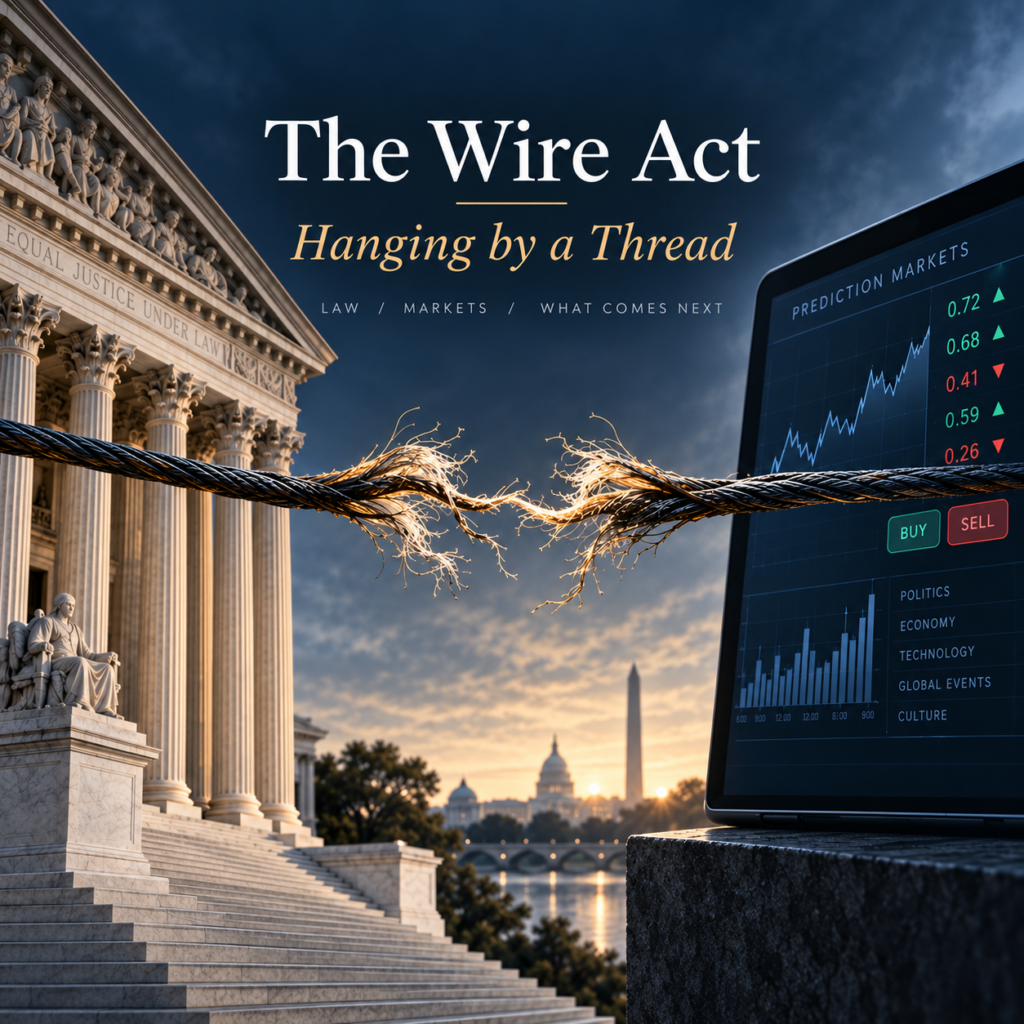
None of this, of course, has prevented various states from objecting in the form of suing Kalshi, seeking injunctions, or even lodging criminal charges as they push back against the loss of state regulatory power. Those cases, and likely additional ones, will play out over this year and next, with the likelihood of a Supreme Court weigh-in being high. But one corollary to all of these changes is the fact that the Wire Act’s utility to federal prosecutors targeting prediction market platforms may be hanging by a thread.
If the Trump Administration’s stance on prediction markets holds, then platforms like Kalshi and Polymarket will be able to operate freely across the U.S. Regulation by CFTC, based on initial appearances, seems to be focused on insider trading concerns.[4] And while many take a jaded view on the distinction between a sporting “event contract” and a sports bet, the industry’s take on the distinction is not without precedent. The definition of “bet or wager” provided in conjunction with the Unlawful Internet Gaming Enforcement Act (31 U.S.C. § 5361, et seq.) specifically excludes “any transaction conducted on or subject to the rules of a registered entity or exempt board of trade under the Commodity Exchange Act.”[5] In other words, Congress has previously defined “bet or wager,” in the context of internet gambling, to not include activities falling within the regulation of the CFTC.
If SCOTUS takes a similar view during the civil and criminal flurry of cases challenging CFTC’s regulatory supremacy, then the only downside for the prediction market platforms will be the mass migration of sportsbook operators to event contract providers. Until that moment, the only certainty is that enforcement of the Wire Act may be shrunk down to foreign and unlicensed sportsbooks, who will almost undoubtedly begin exploring the possibility of migrating to event contracts.
[1]http://www.justice.gov/olc/2011/state–lotteries–opinion.pdf.
[2]986 F.3d 38 (1st Cir. 2021).
[3] Also described as binary options on real-world occurrences.
[4] For example, U.S. Army officer Gannon Ken Van Dyke predicting Venezuelan President Maduro’s capture based on Van Dyke’s access to classified material. (https://www.cftc.gov/PressRoom/PressReleases/9217-26); Michele Spagnuolo using her software engineer background at Google to win contracts on search trends. (https://www.jdsupra.com/legalnews/doj-and-cftc-bring-parallel-insider-9162930/); and White House teleprompter operator Gabriel Perez winning event contracts on words mentioned by President Trump after he had access to speech drafts. (https://www.cftc.gov/PressRoom/PressReleases/9289-26).
[5] 31 U.S.C. § 5362(1)(E)(ii).