Insights < BACK TO ALL INSIGHTS

Maryland’s Ever-Changing Gaming Landscape: Evolution, Adaptation, and Legal Tension
Maryland’s Ever-Changing Gaming Landscape: Evolution, Adaptation, and Legal Tension
By: Abbey Block
Maryland’s Ever-Changing Gaming Landscape: Evolution, Adaptation, and Legal Tension
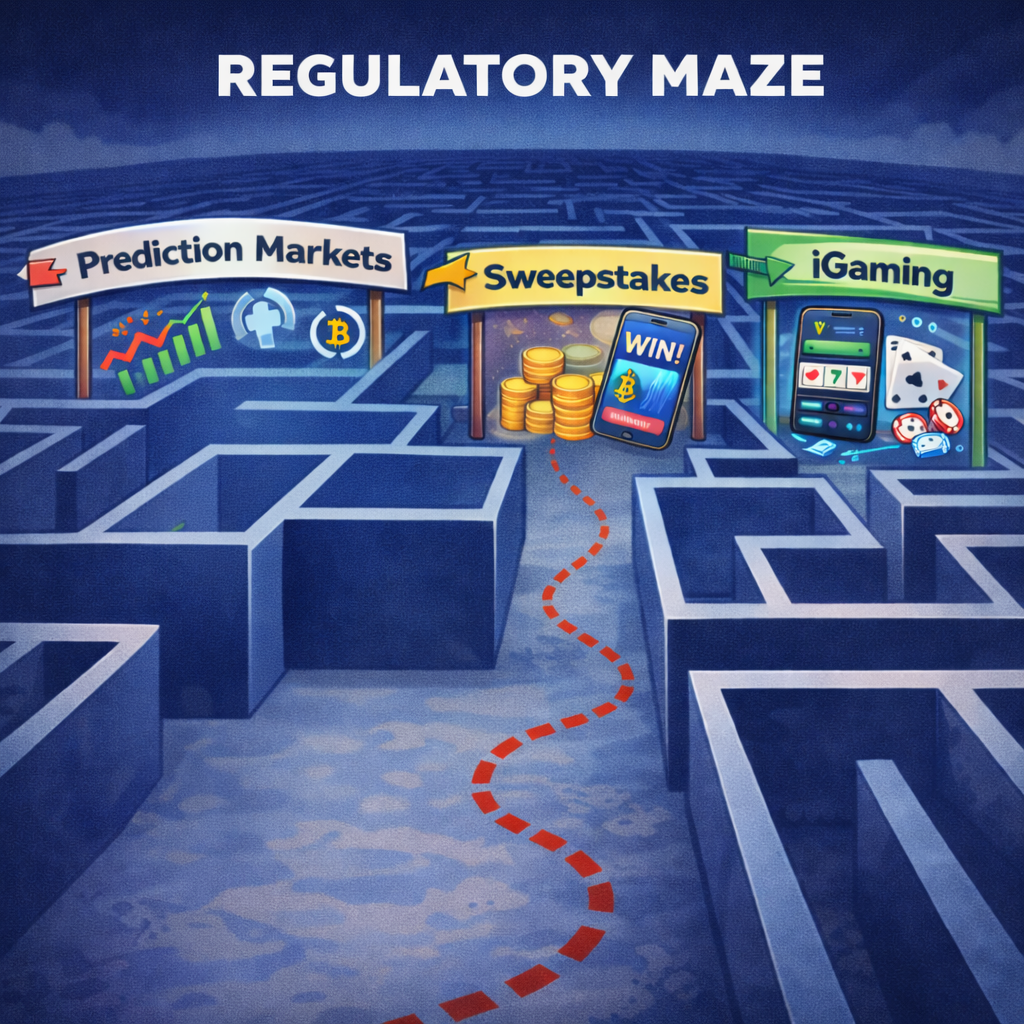
Earlier this month I had the opportunity to attend the 3rd annual Town Hall Meeting, hosted by Morgan State University’s Center for Data Analytics and Sports Gaming Research and National Council of Legislators from Gaming States and participate in a lively discussion about the ever-changing face of gambling. Our panel covered the latest and greatest developments in the gaming industry, including prediction markets, sweepstakes, and iGaming, with particular attention to the way in which the developments in these areas are impacting Maryland’s gaming industry. In case you couldn’t attend, below are the highlights of the discussion.
Prediction Markets – The Latest Model Under the Spotlight
To understand why prediction markets have caused such a shake-up in the gaming industry, it’s important to consider the existing regulatory framework that governs legalized sports wagering. The repeal of the Professional and Amateur Sports Protection Act (PASPA) in 2018 opened the floodgates for states to legalize and extensively regulate sports wagering. Many – now up to 39 states – have accepted the invitation, developing rigorous regulatory frameworks through which sportsbooks must seek licensure and state approval to operate in a given state. Included within each unique regulatory framework are stringent requirements intended to protect the integrity of the sports betting industry and the consumers who participate in it, including the requirement of paying taxes, implementation of consumer protection guardrails (e.g., advertising restrictions, age verification requirements, and responsible gaming resources), and even restrictions on the types of bets that can be offered. Simply put, state regulators exercise a high degree of control over the sports wagering offered to their citizens.
Prediction markets offer their sporting event contracts without obtaining the licensure required by the state gaming regulators. The prediction markets argue that they are not subject to the state regulators’ restrictions because their offerings – sporting event contracts – are financial swaps rather than traditional sports wagers, and, therefore, are not within the purview of state regulation. Unsurprisingly, state regulators disagree, and take the position that the sporting event contracts offered by prediction markets, such as Polymarket and Kalshi, effectively function as sports wagers and, therefore, are subject to state regulation.
State regulators aren’t going down without a fight. Indeed, just last week, the Arizona Attorney General filed criminal charges against Kalshi, accusing the platform of operating an illegal gambling business. More locally, the Maryland Lottery and Gaming Control
Commission unequivocally declared that sporting event contracts constitute “illegal activity” in the state of Maryland and threatened to revoke the state-issued sports wagering license of any business engaging in, operating, offering, or facilitating access to prediction markets for sporting event contracts. In a November 2025 letter, the Commission warned that “any ‘illegal activity,’ in any jurisdiction may bear negatively on [the licensee’s] qualification for Commission-issued license, registration or certification in Maryland.” Simply put, Maryland regulators have threatened to revoke state gambling licenses based upon activity taking place outside of the state’s borders. Other state regulators have issued cease-and-desist letters to event contract platforms, which have sparked a litany of litigation over the issue of federal preemption. That litigation will inevitably end up before the Supreme Court, which may ultimately decide whether prediction market platforms are subject to state regulation.
For its part, the CFTC has announced proposed new rules for the industry and the new chair of the CFTC, Michael Selig, appears ready to lean into these new markets and embrace the agency’s supervisory role. The agency has inserted itself into the ongoing litigation by filing “friend of the court” briefs in support of the prediction markets and the CFTC’s supremacy, and Selig has publicly stated that the “CFTC will no longer sit idly by while overzealous state governments undermine the agency’s exclusive jurisdiction over these [prediction] markets by seeking to establish statewide prohibitions on these exciting products.”
In sum, the emergence of sporting event contracts and prediction markets has caused quite a stir in the gaming industry, threatening the existing regulatory frameworks which have governed since 2018. State regulators are pushing back against this potential impingement upon their authority, and the debate of state versus federal authority will likely play out before the country’s highest judicial authority. Regardless of the way in which the Supreme Court rules, the gaming industry will undoubtedly be required to adapt and evolve to address these new developments.
Sweepstakes – A New Take on a Traditional Framework Faces Regulatory Scrutiny
Sweepstakes casinos, which offer a new spin on the traditional sweepstakes framework (allowing for free participation in games of chance for the opportunity to win a prize) through the use of a dual virtual currency system, are similarly under stringent regulatory scrutiny. In early March, the Maryland Lottery and Gaming Control Agency issued a second round of cease-and-desist letters to the online platform operators, asserting that their business operations constitute unlawful real-money online gaming unauthorized by Maryland law.
The state’s legislature has also turned its attention to the sweepstakes casino industry, proposing several pieces of legislation intended to explicitly prohibit the platforms. By way of example, Maryland SB 112/HB 295, titled “Prohibition on Interactive Games and revenue from Illegal Markets” prohibits “interactive games” which are defined as any online or mobile game that “utilizes multiple currency systems of payment allowing the player to exchange the currency for any prize or award or cash or cash equivalents” and “simulates casino-style gaming… lottery games… or sports wagering.” However, the bill explicitly excludes from this definition games that solely award non-cash prizes. Notably, the bill seeks to infiltrate the entire sweepstakes casino ecosystem by requiring licensed Maryland operators to disclose any business relationship with a “financial institution, payment processor, geolocation provider, gaming content supplier, platform provider, or media affiliate that is known to support, operate, conduct, or promote an interactive game in the State.” This means that licensed gaming operators and their suppliers (i.e., those that provide sweepstakes casinos with gaming content, geolocation services, identity verification tools) will effectively be required to sever their business relationships with sweepstakes casinos, or risk losing their state-issued licenses. Another piece of proposed legislation, Maryland HB 1226/SB 652, known as the “Maryland Illegal Online Gambling Enforcement Act” would empower the Attorney General to issue cease-and-desist orders to any operator accused of offering or promoting “illegal online gambling” in the state and would impose criminal penalties for violators who fail to comply. However, the bill defines the term “online gambling” to include any system that accepts “wagers” not only in games of chance (such as those offered on sweepstakes casino platforms) but also games of skill. Notably, games of skill have typically been exempted from the definition of gambling under Maryland law. Thus, the bill’s inclusion of games of skill within the definition of illegal online gambling would upend decades of Maryland precedent, which has traditionally allowed for games in which the outcome is predominantly determined by skill rather than chance.
iGaming – The Journey to Legalization Implicates Concerns and Competition
Our panel’s discussion concluded by considering Maryland’s long-winding journey to the legalization of iGaming in the state. Opponents of such a measure argue that iGaming – i.e., the offering of online casino games – implicates serious consumer protection concerns. They argue that unlike sports wagering, which typically centers around a particular sporting event of finite duration, online casinos could potentially be made continuously available – creating ample opportunity for the development of addictive and compulsive gambling behavior. Furthermore, opponents raise concerns that the legalization of iGaming will cannibalize business from brick-and-mortar casinos (a proposition which has repeatedly proven to be false).
On the other side of the debate, proponents of iGaming argue that legalization is the most effective way to protect consumers. They contend that online gambling is already happening, but is taking place via unregulated, offshore platforms. They assert that if iGaming is legalized and regulated, state regulators can implement guardrails such as advertising restrictions, age controls, and responsible gaming resources, not otherwise required for the offshore platforms currently operating without restriction or oversight.
At the time of our panel, legalization of iGaming in Maryland remained a possibility. A proposed bill, Maryland’s SB 885 would empower the Maryland Lottery and Gaming Control Commission with the authority to issue iGaming licenses in the state. Underlying this pending legislation is the reality that the state is facing competitive pressure from Virginia, where legislators were similarly debating measures that would authorize online casinos in addition to the addition of a brick-and-mortar casino. Simply put, if Maryland legislators don’t act to legalize iGaming, they risk losing valuable tax revenue if and when Viriginia moves forward with its own gaming regulation.
Looking Ahead
The title of our panel – “the ever-changing face of gambling” could not have been more appropriate. Our hour-long discussion, while undoubtedly comprehensive, merely scratched the surface of the industry’s dynamic and transformative evolution. If the last year is any indication of the industry’s capacity for change, I feel confident that in the coming weeks, months, and years, the country’s approach to the regulation of online gaming will continue to evolve and adapt. The players in the industry – regulators, lawyers, developers, and entrepreneurs – simply need to keep up!