Insights < BACK TO ALL INSIGHTS

I Predict the FTC and Class Action Plaintiffs May Have a Problem with Prediction Market Influencers
I Predict the FTC and Class Action Plaintiffs May Have a Problem with Prediction Market Influencers
By: Michelle Cohen
Prediction markets are the hottest topic in gaming right now. Industry leaders Kalshi and Polymarket have provided substantial fodder for debates at the summer gaming conferences, in the gaming trade press, and in mainstream media. Most of that discussion focuses on state versus federal regulation, an issue that the U.S. Supreme Court will likely need to resolve. In the interim, as they promote their platforms across the U.S., prediction markets face the same customer acquisition challenges as any other online gaming business seeking new customers. To source new customers, Kalshi and Polymarket have invested millions in social media ads. Importantly, these companies have focused on social media influencers to promote their brands.
Of course, there is nothing inherently wrong with influencers touting the benefits of Kalshi, Polymarket, or any other online platform. However, since 2009, the Federal Trade Commission (“FTC”) has required that influencers make certain “clear and conspicuous” disclosures when they discuss a brand or product and have a “material connection” such as receiving compensation (which can include payments from the brand, free products, or other benefits). These disclosures further the FTC’s oversight of truthful advertising by informing the public that the influencer has a material connection to the advertised brand (and thus may not be completely impartial). Consumers can then make an informed decision about the influencer’s recommendation, taking into account the fact that the influencer is compensated or receives benefits from the brand. On Instagram, X, Facebook, and other social media, this disclosure is often designated by #sponsored or #paidinfluencer or similar verbiage. There are different methods of disclosure depending on the medium (e.g., repeating the disclosure at various points in a YouTube video).
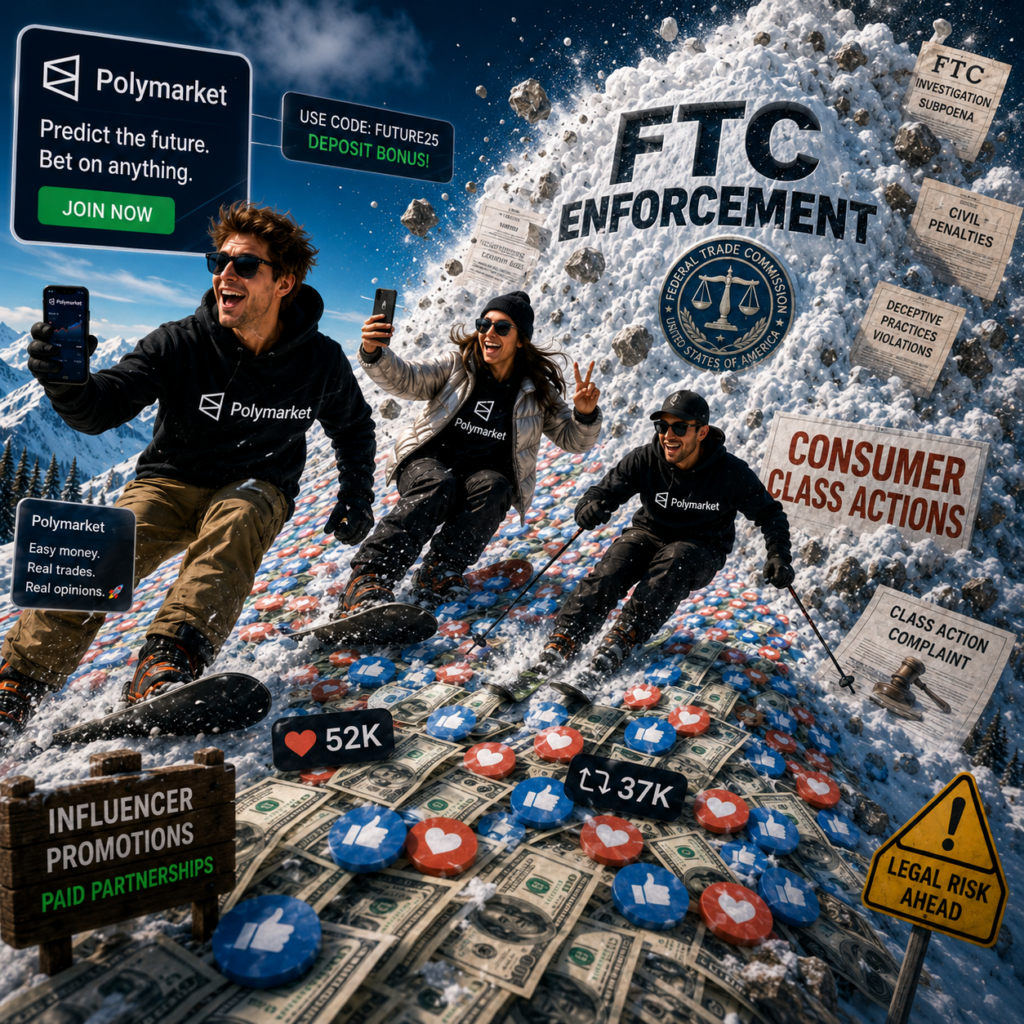
What happens when prediction market influencers do not disclose these material connections? Well, we may soon find out. Politico recently reported that Polymarket’s chief marketing officer paid influencer Nick Shirley and others over $350,000 (from a personal PayPal account). Politico reported that over $2.5 million was sent to more than 800 people during a 14-month span. At least 20 of these people promoted Polymarket. When posting about Polymarket, these influencers failed to disclose their paid relationship, as required by the FTC – for example, per Politico, this occurred at least 490 times on X.
Recent developments suggest that regulators and self-regulatory bodies are already paying close attention to these issues. Last week, BBB National Programs’ National Advertising Division referred Kalshi to appropriate regulatory authorities following an inquiry into whether material connections between Kalshi and influencers or affiliates were being clearly and conspicuously disclosed.
In the past, the FTC has fined influencers and brands for social media posts that failed to disclose material connections (and, in some cases were also otherwise false or deceptive). Teami, a tea and skincare company touted by influencers including Cardi B and Jordin Sparks, settled an FTC action in 2020. The order imposed a $15.2 million judgment—the total sales of the challenged products—which was suspended upon payment of $1 million, based on the defendants’ inability to pay the full judgment.
Apart from FTC enforcement, the failure to make the required disclosures (or making disclosures that are not clear and conspicuous) can also result in consumer class actions. Class action firms have launched lawsuits alleging violations of state consumer protection statutes and the FTC endorsement guidelines in courts in California, Florida, and Illinois.
Rather than turning a blind eye or even encouraging posts that do not disclose payments or other consideration, the prediction market platforms, any gaming company and businesses in general, should have clear rules for influencers to comply with the FTC guidelines and to disclose material connections in their posts. Companies should periodically audit compliance and take action (such as requiring removal of posts and terminating relationships). These actions can help demonstrate good faith efforts to comply with the FTC disclosure requirements.