Insights < BACK TO ALL INSIGHTS

Cold Water on Insider Trading Fears: Prediction Markets Miss the 2026 NFL Draft
Cold Water on Insider Trading Fears: Prediction Markets Miss the 2026 NFL Draft
By: John Mikuta
From April 23 to April 25, the National Football League (“NFL”) held its annual player selection draft. Over 800,000 fans gathered in Pittsburgh, Pennsylvania to watch Commissioner Roger Goodell announce the picks live, with millions more watching on TV and other digital platforms.[1] But the NFL Draft is not just a spectator event—both traditional sportsbooks and prediction-market platforms allowed customers to risk money predicting which player would be selected first, how many quarterbacks would be chosen, and when particular players would come off the board.[2]
NFL Draft betting took off in 2020, when COVID-19-related shutdowns brought most sports to a grinding halt. Until then, a typical draft garnered only about $1 million in wagers. The 2020 NFL Draft, however, saw an estimated $5–$20 million in wagers, and tens of millions of dollars have continued to be wagered annually on subsequent drafts.[3] Additionally, in 2026, users of Kalshi, the most prominent prediction-market platform offered in the United States,[4] staked another $15.45 million on the event.
Unlike traditional sports betting, which typically involves a game between two teams decided on a playing field, NFL Draft betting outcomes depend entirely on information. Those who can obtain information about, for example, which teams are prioritizing which players can gain significant advantages over the markets. And once credible information emerges and is wagered upon, the market can move quickly and sharply.[5]
In light of the recent rise of prediction markets, the NFL sent letters to several prediction-market operators asking them to remove certain types of offerings that could be determined in advance or easily manipulated.[6] This, of course, includes draft picks. The NFL “flagged prediction markets as being particularly susceptible to insider abuse in the wake of multiple high-profile trades that accurately predicted the onset of U.S. military action in Iran and Venezuela.”[7]
The prediction-market platforms, however, declined to withdraw their markets. Multiple former NFL executives characterized prediction-market offerings as “scar[y]” and “worrisome.” [8] One even was quoted as believing that “disaster is likely.”[9]
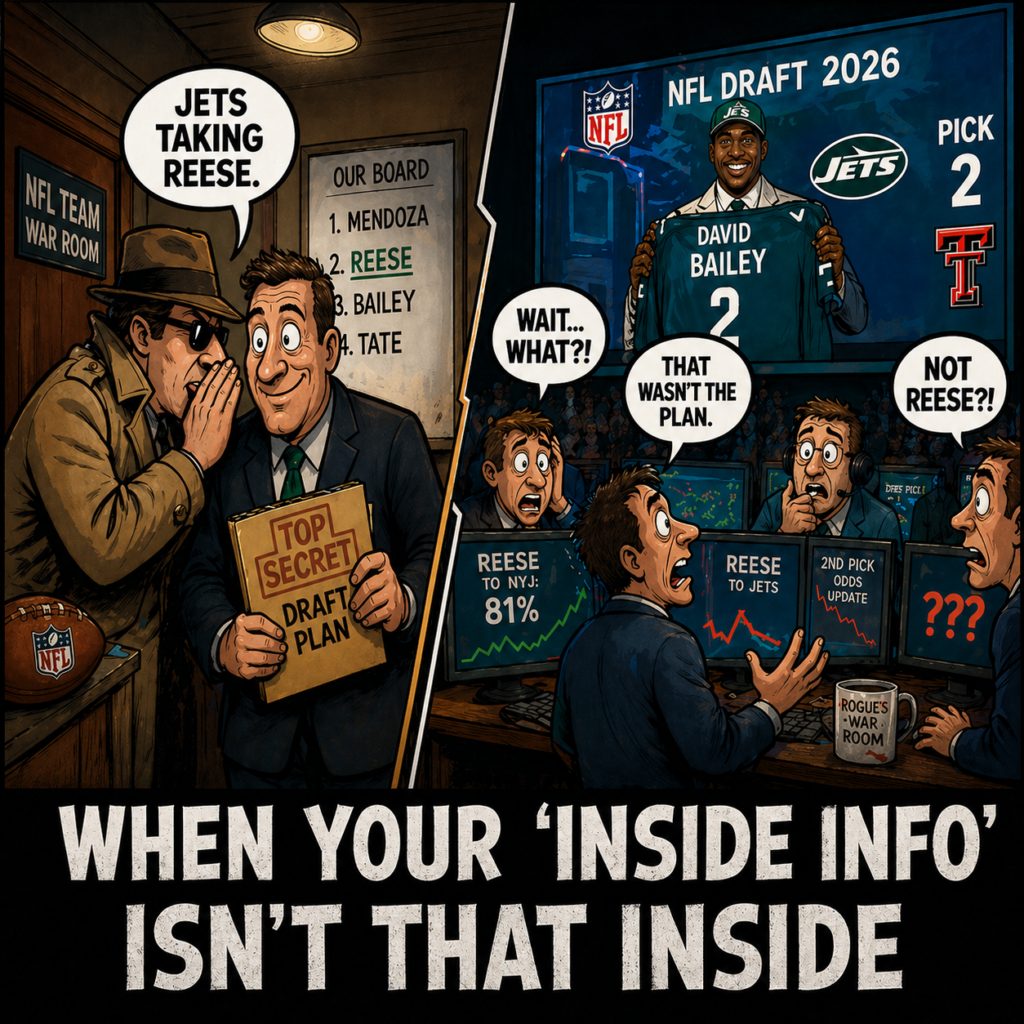
Nevertheless, those predictions of doom did not materialize. Breaking from the past trend of betting and trading markets being reliably predictive of actual NFL Draft results, both prediction markets and traditional sportsbooks surprisingly missed the mark in 2026.[10] As widely expected, Indiana quarterback Fernando Mendoza was selected first by the Las Vegas Raiders. But as early as the second pick, the markets got it wrong.
For example, Kalshi assigned an 81 percent probability that the New York Jets would select Ohio State’s Arvell Reese with the second selection, only for the Jets to instead choose Texas Tech’s David Bailey.[11] That surprise selection, in turn, affected the market for the third-overall pick, where Bailey had been widely expected to go. And with the fourth pick, the Tennessee Titans unexpectedly selected Ohio State’s Carnell Tate, which had a meager 3.8-percent chance of happening on Kalshi.[12]
The poor accuracy of prediction markets in forecasting the 2026 NFL Draft pours cold water on the narrative that prediction markets are incurably susceptible to, and rife with, insider trading abuses. Despite the fact that NFL Draft markets are inherently and entirely dependent on information, and the fact that presumably dozens of employees of each team had inside knowledge of which players their team preferred, that information did not substantially or improperly influence the prediction-market landscape.
While this is undoubtedly a testament to NFL teams’ confidentiality practices, prediction markets such as Kalshi have recently instituted policies intended to rein in insider trading and market manipulation. On March 23, 2026, Kalshi announced that it had implemented a policy to preemptively block all athletes, team personnel, and officials involved in college and professional sports from trading in markets associated with the sports they are in involved in.[13] Kalshi partnered with IC360, an integrity and compliance firm, to bolster its surveillance and flag suspicious activity on both its platform and other platforms that offer sports-related markets.[14]
Kalshi also announced that it had launched a similar policy to preemptively block candidates for public office from trading on their own campaigns—another area with significant potential for insider trading and market manipulation.[15] Notably, on April 22, 2026, Kalshi announced that it had fined and suspended three accounts from political candidates that had traded on the outcomes of their own elections.[16]
The Commodity Futures Trading Commission (“CFTC”), the federal agency that oversees prediction-market operators such as Kalshi, has also begun to crack down on insider trading and market manipulation. In one advisory, the CFTC expressly cautioned operators that listing event contracts that are contrary to the public interest or susceptible to manipulation may violate federal law.[17] Furthermore, the CFTC solicited public comments on potential future rulemaking that could address, among other things, trading on non-public information.[18]
It remains to be seen whether action from the CFTC and/or operators like Kalshi can continue to be effective at curbing abusive trading practices in the growing prediction-market sphere. But the 2026 NFL Draft was, at a minimum, a positive data point.
[1] Michael Guise, A record number of people attended the NFL Draft in Pittsburgh Thursday, CBS News (Apr. 24, 2026), https://www.cbsnews.com/pittsburgh/news/pittsburgh-nfl-draft-attendance-record/.
[2] See, e.g., Pro Football Draft, Kalshi, https://kalshi.com/category/sports/football/pro-football-draft/.
[3] Wayne Parry, Virus shutdowns will likely make NFL Draft most bet on ever, ABC 10 (Apr. 22, 2020), https://www.abc10.com/article/news/nation-world/virus-shutdowns-will-likely-make-nfl-draft-most-bet-on-ever/507-9fdad907-44cc-4868-acaf-e625435d44ea.
[4] Erich Richter, Sharp betting money swung and missed on the 2026 NFL Draft, New York Post (Apr. 23, 2026), https://nypost.com/2026/04/23/betting/sharp-betting-money-swung-and-missed-on-the-2026-nfl-draft/.
[5] Ben Fawkes, 2026 NFL Draft: ‘A necessary evil’—Why oddsmakers hate offering NFL Draft markets, Yahoo! Sports (Apr. 23, 2026), https://sports.yahoo.com/nfl/betting/article/2026-nfl-draft-a-necessary-evil–why-oddsmakers-hate-offering-nfl-draft-markets-145423149.html.
[6] Robert Klemko, Prediction markets create new leak temptations for NFL draft, ESPN (Apr. 22, 2026), https://www.espn.com/nfl/story/_/id/48496515/nfl-draft-picks.
[7] Id.; see also John Mikuta, CFTC Plants the Flag on Regulating Prediction Markets, Ifrah on iGaming (Mar. 4, 2026); John Mikuta, Prediction Markets Raising Predictable Questions of Regulation, Public Policy, Ifrah on iGaming (Jan. 27, 2026).
[8] Id.
[9] Id.
[10] Richter, supra n. 4.
[11] Id.
[12] Id.
[13] Bobby DeNault, New guardrails to prevent insider trading and manipulation in politics and sports, Kalshi News (Mar. 23, 2026), https://news.kalshi.com/p/kalshi-new-guardrails-insider-trading-politics-sports.
[14] Prohibited and Unlawful Trading Activity, Kalshi, https://kalshi.com/market-integrity/prohibited-trading (last accessed Apr. 24, 2026).
[15] See, e.g., John Mikuta, CFTC Plants the Flag on Regulating Prediction Markets, Ifrah on iGaming (Mar. 4, 2026).
[16] Bobby DeNault, Enforcement update: Kalshi continues crackdown on political insider trading, Kalshi (Apr. 22, 2026), https://news.kalshi.com/p/kalshi-political-insider-trading-enforcement-update.
[17] CFTC Staff Issues Prediction Markets Advisory, CFTC Release No. 9193-26 (Mar. 12, 2026), https://www.cftc.gov/PressRoom/PressReleases/9193-26
[18] CFTC Seeks Public Comment on Advanced Notice of Proposed Rulemaking Relating to Prediction Markets, CFTC Release No. 9194-26 (Mar. 12, 2026), https://www.cftc.gov/PressRoom/PressReleases/9194-26.