


Insights < BACK TO ALL INSIGHTS

The United Kingdom Institutes a Voluntary Code of Good Practice for Operators of Prize Draws
The United Kingdom Institutes a Voluntary Code of Good Practice for Operators of Prize Draws
By: John Mikuta
The United Kingdom has published a Voluntary Code of Good Practice for operators of prize draws and competitions (“PDCs”).[1] The Code contains a wide range of key measures that operators are expected to implement to improve player safety and transparency. Because the Code is voluntary, operators are not legally bound to abide by it. However, dozens of operators and other relevant entities in the United Kingdom have already committed to implementing the Code’s guidelines.
The PDC market in the United Kingdom is worth £1.3 billion annually, with 7.4 million adult participants and over 400 total operators. Despite the size of the market, the PDC industry in the United Kingdom, as in the United States, is subject to no formal regulation. The U.K.’s Gambling Act 2005, which governs lotteries, does not regulate PDCs. PDCs share some similarities to traditional lotteries: most players purchase tickets to enter, and prizes are awarded at least partially based on chance. But while lotteries must (1) obtain a license from the U.K. Gambling Commission, (2) implement mitigation measures such as limiting prize sizes and ticket sales, and (3) make minimum charitable contributions of around 20% of proceeds,[2] PDCs are not subject to these legal requirements since, unlike lotteries, they offer a free entry option.
In 2023, the Department for Culture, Media and Sport (“DCMS”) commissioned a study to research the PDC industry and the rise in growth of the PDC market and assess whether government intervention was warranted. In June 2025, DCMS published its report.[3] The report concluded that some PDC players were experiencing gambling and consumer harm, and that PDCs are addictive. The report also found that PDC operators provide insufficient information about the likelihood of winning and how winners are chosen. Finally, the report determined that PDCs are competing with and taking business from regulated lotteries, resulting in lower charitable donations.
The report proposed three alternative approaches. First, the report considered whether PDCs should be treated like formal lotteries and regulated by the U.K. Gambling Commission. Second, the report proposed more assertive enforcement of current consumer protection rules. And third, the report suggested the implementation of a voluntary code of conduct for PDC operators to follow. The report noted that the voluntary code option was preferred by the industry because it would be quick and inexpensive to implement.
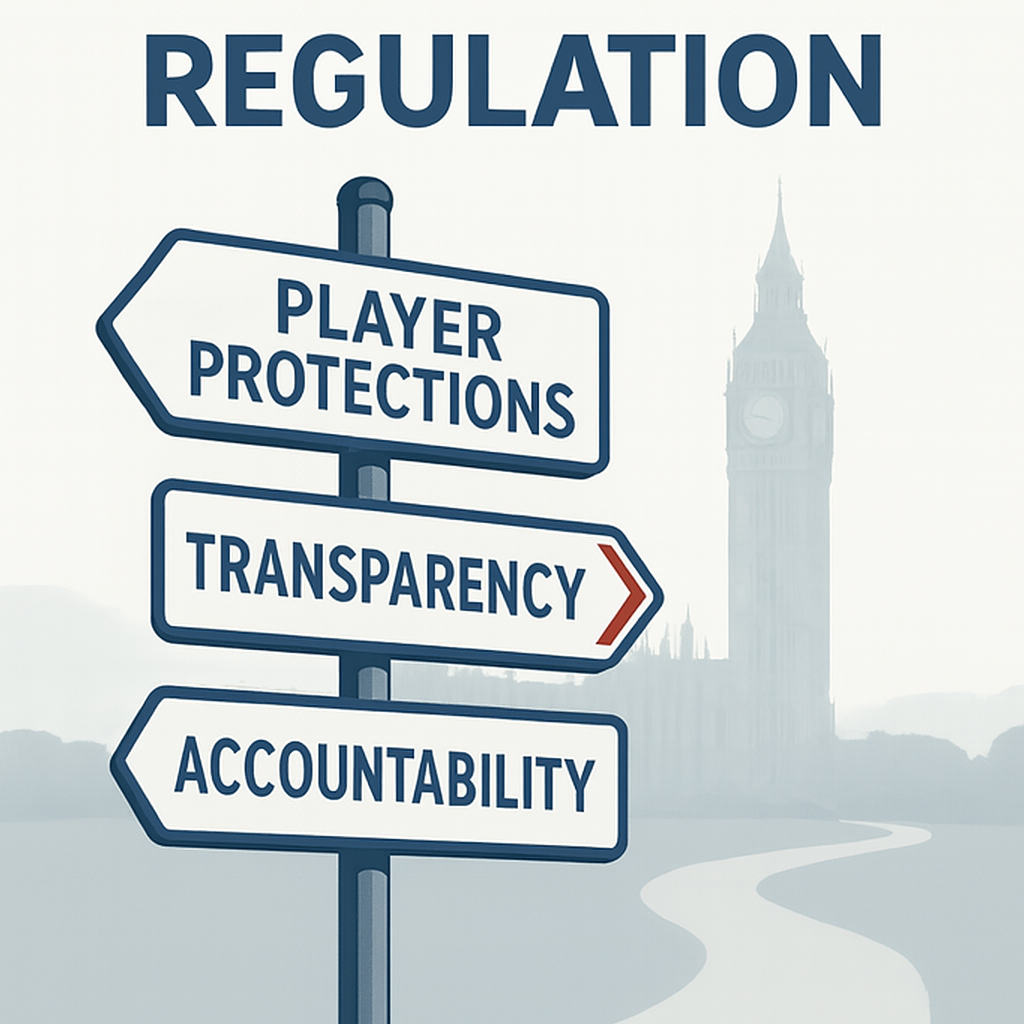
Shortly after the report was published, DCMS announced that it would promulgate a Voluntary Code,[4] and on November 21, 2025, it did so. The Code categorizes its measures into three distinct sections: Player Protections, Transparency, and Accountability.
For Player Protections, the Code’s measures include the following:
- Operators should make PDCs available only to those 18 and older and should implement a reasonable age verification process to ensure compliance.
- Operators should have an appropriate, transparent, and robust complaint and dispute resolution process.
- Operators should not accept more than £250 per month of credit card payments per player and should not accept any credit card payments for instant-win prize draws.
- Operators must set suitable and proportionate maximum monthly spending limits for all players and allow players to set their own individual monthly spending limits.
- Operators should provide options for players to suspend or close their accounts.
- Operators must make reasonable efforts to monitor player activity for potential harm, such financial, social, or psychological distress and excessive participation. When indicators of harm are identified, operators must take a tailored and proportionate approach to intervention to mitigate harm and ensure responsible play.
- Operators should guide players to available support resources for those experiencing harm.
- Operators should ensure an appropriate time period elapses between a prize draw opening and closing.
- Operators should ensure compliance with and equivalence between paid and free methods of entry.
- Operators should ensure that marketing is undertaken in a socially responsible manner.
For Transparency, the Code provides the following:
- Operators must clearly summarize how the prize draw will be conducted alongside disclosure of relevant rules, game mechanisms, the likelihood of winning a prize, and which prizes are to be awarded.
- Operators should ensure that prizes are fairly awarded and that all entries, paid or free, have an equal chance of winning.
- Operators should clearly and prominently provide players with details of free entry options before the point of purchase.
- Operators should provide winners with the advertised prize or a reasonable cash alternative.
- Operators who provide a charitable contribution as part of a prize draw must outline the parameters of their contributions.
Accountability
- Operators should implement processes to regularly monitor and review compliance with the Code, and should ensure that all Code requirements are followed by any third parties who support their prize draw operations.
- Operators should engage with other operators to share best practices and should share their player protection, transparency and accountability measures on their websites.
Signatories to the Code agree to implement it no later than May 20, 2026. While the Voluntary Code is not legally enforceable, DCMS cautioned that if the Code is not suitably implemented or complied with, then it will “consider all available options.”
Given the lack of legal enforcement mechanisms, the success of the Voluntary Code will likely depend on how it is embraced by PDC operators. If the Code is widely embraced and followed, then any further legally enforceable regulation is unlikely. But by stating that it would “consider all available options” if the Code is not complied with, DCMS left open the possibility of further regulatory action.
United States prize draw operators do not operate in as clear a legal area as those in the United Kingdom now do. Nevertheless, tracking developments in the United Kingdom and adopting the Voluntary Code’s measures is a best practice, even if not a legal defense. Implementing the Code’s measures would likely increase consumer confidence and ward off formal legal regulation. If the Code proves to be successful in streamlining customer confidence and safety while avoiding costly regulation, operators in the United States could even consider establishing their own Voluntary Code.
[1] Department of Culture, Media and Sport (2025) Voluntary Code of Good Practice for Prize Draw Operators, https://www.gov.uk/government/publications/voluntary-code-of-good-practice-for-prize-draw-operators/voluntary-code-of-good-practice-for-prize-draw-operators (last accessed Nov. 25, 2025).
[2] Gambling Act 2005, c. 19, §§ 252–65.
[3] Department of Culture, Media and Sport (2025) Research Report: Online Prize Draws and Competitions Market Study, Assessment of Harm and Review of Potential Interventions, https://www.gov.uk/government/publications/research-report-online-prize-draws-and-competitions-market-study-assessment-of-harm-and-review-of-potential-interventions (last accessed Nov. 25, 2025).
[4] Baroness Twycross, Society Lotteries Sales Limits and Prize Draws (2025), UIN HLWS739, https://questions-statements.parliament.uk/written-statements/detail/2025-06-26/hlws739 (last accessed Nov. 25, 2025).

