Insights < BACK TO ALL INSIGHTS

In the Market for Judicial Review: Circuit Split on CFTC Preemption Makes SCOTUS a Predictable Destination
In the Market for Judicial Review: Circuit Split on CFTC Preemption Makes SCOTUS a Predictable Destination
By: John Mikuta
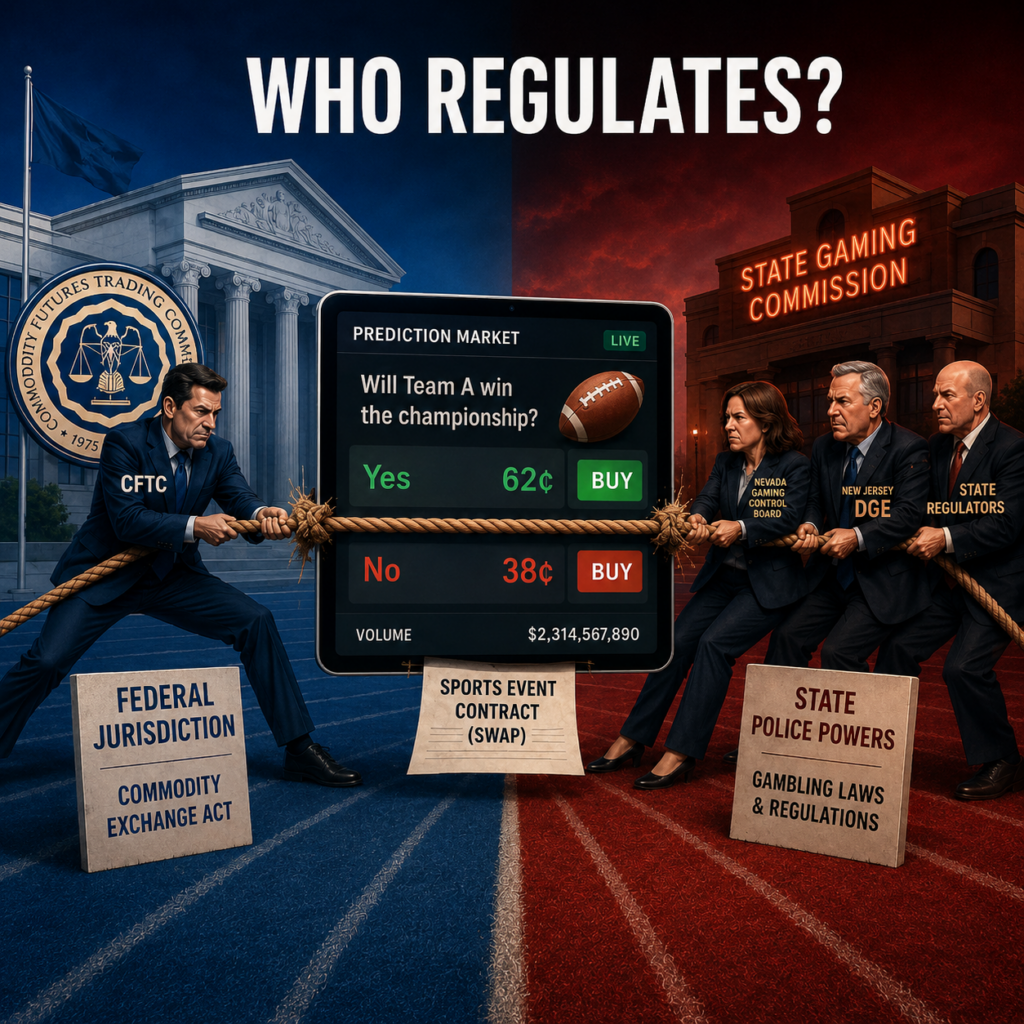
The ongoing legal battle over whether the federal Commodity Futures Trading Commission (“CFTC”) or state regulators have the authority to regulate sports-related prediction markets is heating up.
Last week, the U.S. Court of Appeals for the Ninth Circuit turned away a challenge by Kalshi, the largest prediction market in the United States, to the Nevada Gaming Control Board’s letter ordering it to cease and desist operations in the state of Nevada.[1] The Ninth Circuit held that the lower court did not abuse its discretion in concluding that Kalshi was not entitled to a preliminary injunction because it did not establish a likelihood that the federal Commodity Exchange Act (“CEA”) preempts state gaming regulations.
The Ninth Circuit’s ruling stands in direct contrast to the U.S. Court of Appeals for the Third Circuit’s ruling in April 2026. There, a divided panel concluded that Kalshi demonstrated a reasonable likelihood of success on its claim that the CEA preempts state laws and thus affirmed a preliminary injunction preventing the New Jersey Division of Gaming Enforcement from enforcing state regulations against Kalshi’s federally regulated event contracts.[2]
These two contrasting rulings from federal courts of appeals set the stage for the Supreme Court to step in and decide the issue. When courts of appeals reach different conclusions on the same statutory question, the Supreme Court typically takes notice. Given that this question involves a rapidly growing, multi-billion-dollar industry, a Supreme Court showdown appears likely.
The Ninth Circuit’s decision created what is commonly called a “circuit split”—a disagreement between two courts of appeals. Circuit splits are one of the primary factors that the Supreme Court considers in deciding whether to take up a case. Right now, the same federal law—the CEA—is being applied differently across different regions of the country. In the Third Circuit, states cannot regulate Kalshi’s and other CFTC-licensed prediction markets’ event contracts. In the Ninth Circuit, states can.
But not all circuit splits are created equal. Some circuit splits are messy. Some involve convoluted and different sets of facts. Others involve different lines of precedent that the courts must balance. Unsurprisingly, the Supreme Court is more interested in resolving clean splits that allow the Court to quickly and incisively decide the disputed issue of law without getting bogged down by fact-specific inquiries.[3]
The legal issue dividing the Third and Ninth Circuits here is particularly clean and ripe for Supreme Court review. The two decisions involve the same underlying facts, and both were decided at the same preliminary injunction stage.
The courts’ legal analysis turned on the same question—whether the CEA’s conferral of exclusive jurisdiction upon the CFTC to regulate “swaps” encompasses sports-related event contracts. Both the Third and Ninth Circuits looked at the same statutory definition of a swap—a transaction that is “dependent on the occurrence . . . of an event or contingency associated with a potential financial, economic, or commercial consequence”[4]—and decided whether sports event contracts fell within that definition.
The Supreme Court will not need to wade through a dense factual record or reconcile different bodies of caselaw relied upon by the courts of appeals. It can cut right to the heart of the statutory interpretation issue and render a single ruling that gives the CEA the same interpretation throughout the country.
Further, the division of opinion among lower courts is not confined to the Third and Ninth Circuits. District courts across the country are deeply split on this same CEA issue.[5] And the CFTC itself has intervened in several lawsuits and brought several lawsuits of its own, seeking to enjoin states from encroaching on what it sees as its exclusive regulatory authority to oversee prediction markets.[6] It is plausible that the Solicitor General’s Office will appear as an amicus and also ask the Supreme Court to take up this issue.
So, when can a final decision from the Supreme Court be expected? While that depends on how quickly the parties want to move, the table is set for a decision in June 2027. The state of New Jersey has an extended deadline of September 3 to file a petition for a writ of certiorari from the Third Circuit’s decision.[7] With a circuit split now present, New Jersey could submit its petition this week. Kalshi has 90 days to file its own petition from the Ninth Circuit’s decision,[8] meaning we could see petitions in both cases filed by late 2026. That would allow the Court to have briefing in early 2027, potentially hear oral argument in spring, and render a decision before the end of its term in June 2027.
Of course, several factors could slow the timing down. New Jersey or Kalshi (or both) could ask the respective court of appeals to rehear the case en banc (before all judges in the circuit). The Supreme Court could decide to wait and allow litigation to continue percolating in the lower courts, particularly given that the Fourth and Sixth Circuits are both considering the issue.[9]
And there is another wild card—the CFTC’s proposed rulemaking, which would establish a new framework for evaluating whether sports-related event contracts involve harmful or illegal activities under the CEA and contravene the public interest.[10] The Court could wait to see whether the new regulations moot or reshape the dispute.
Regardless, a direct, clean circuit split on a high-dollar, high-profile federal statutory interpretation issue, which the federal government has been actively involved in litigating, presents an ideal set of circumstances for Supreme Court review. It will likely be only a matter of time before the Supreme Court weighs in.
[1] KalshiEX, LLC v. Assad, No. 25-7516, — F.4th — (9th Cir. Aug. 28, 2026).
[2] KalshiEX, LLC v. Flaherty, 172 F.4th 220 (3d Cir. 2026).
[3] See generally Kelsey Dallas, SCOTUSBlog, The art of the circuit split: an explainer (Feb. 17, 2026), https://www.scotusblog.com/2026/02/the-art-of-the-circuit-split-an-explainer/.
[4] See 7 U.S.C. § 1a(47)(A).
[5] E.g., compare KalshiEX LLC v. Johnson, No. 2:26-cv-1715 (D. Ariz. Apr. 10, 2026), and KalshiEX LLC v. Orgel, No. 3:26-cv-00034 (M.D. Tenn. Feb. 19, 2026) (enjoining the states of Arizona and Tennessee, respectively, from enforcing gambling laws against event contracts on CFTC-licensed markets such as Kalshi) with Kalshiex LLC v. Martin, No. 1:25-cv-1283, Dkt. No. 71 (D. Md. Aug. 1, 2025), and KalshiEX LLC v. Schuler, No. 2:25-cv-1165 (S.D. Ohio Mar. 9, 2026) (denying Kalshi’s motions for preliminary injunctions).
Update: On September 2, 2026, New Jersey filed its cert petition from the Third Circuit’s decision, placing the circuit split with the Ninth Circuit squarely in the hands of the Justices. The Supreme Court now has the opportunity to resolve the growing conflict over whether federal law preempts state regulation of sports-related event contracts.
[6] See, e.g., John Mikuta, Ifrah on iGaming, CFTC Predicting Litigation Success over Multiple States (June 8, 2026), https://www.ifrahlaw.com/ifrah-on-igaming/cftc-predicting-litigation-success-over-multiple-state/.
[7] Flaherty v. KalshiEX, LLC, No. 25A1465, https://www.supremecourt.gov/search.aspx?filename=/docket/docketfiles/html/public/25a1465.html.
[8] S. Ct. R. 13.
[9] Kalshiex LLC v. Martin, 25-1892 (4th Cir. filed Aug. 6, 2025); Kalshiex LLC v. Schuler, No. 26-3196 (6th Cir. filed Mar. 11, 2026).
[10] CFTC Seeks Public Comment on Notice of Proposed Rulemaking Concerning Evene Contracts Involving Enumerated Activities, CFTC Release No. 9249-26 (June 10, 2026), https://www.cftc.gov/PressRoom/PressReleases/9249-26.