Insights < BACK TO ALL INSIGHTS

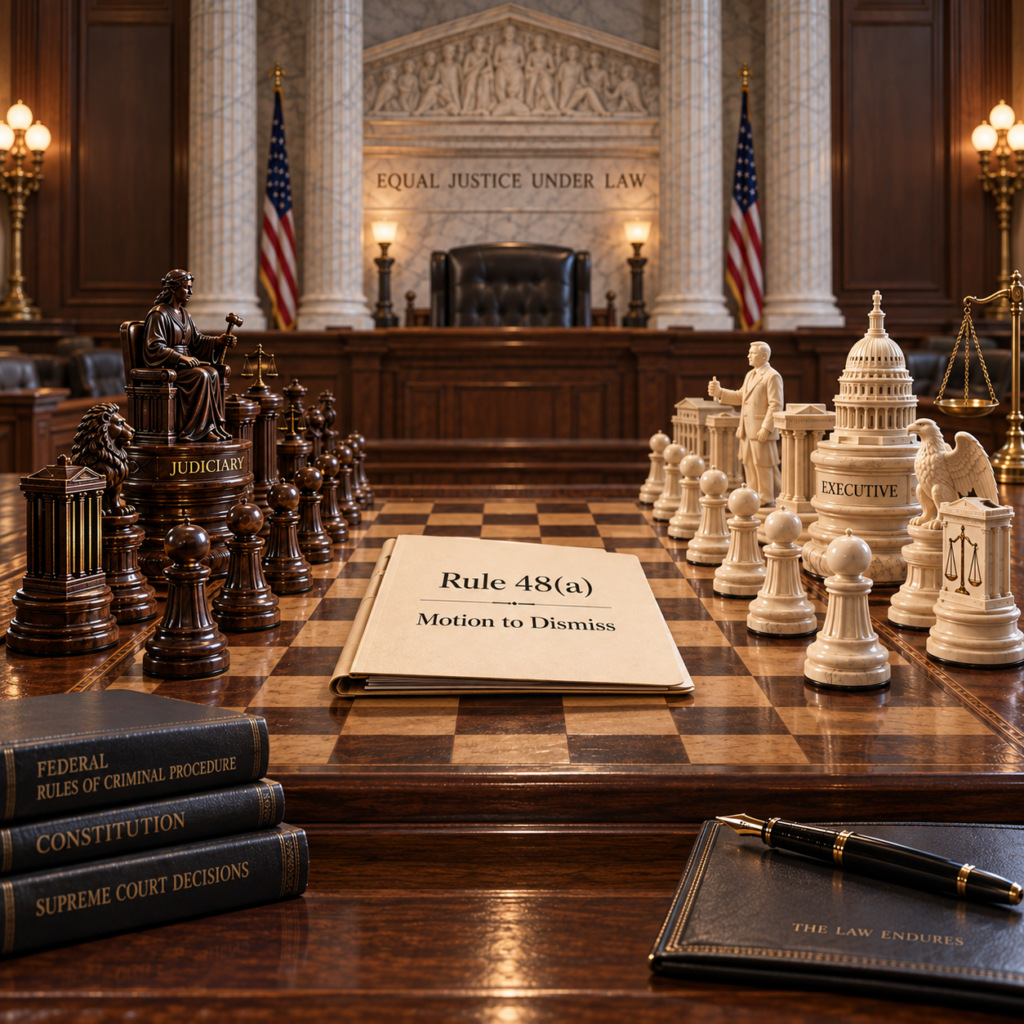
Dismissive of Dismissal
FEATURED
September 25, 2026
Dismissive of Dismissal
By: James Trusty
During the two Trump administrations, a trend has begun to emerge of federal judges challenging the once-unrestricted authority of the Department of Justice (DOJ) to dismiss indictments. The longstanding framework of separation of powers suggests this judicial pushback is unsupported activism, but the judges claim the Federal Rules of Criminal Procedure (“Rules”) do not relegate their role to rubber stamping. Ultimately, this trajectory may lead us to an impossible impasse—a game of chicken where reputations, relationships and the balance of power might be forever altered in the context of dismissal. Pursuant to Rule 48(a), “[t]he government may, with leave of court, dismiss an indictment.” Exactly what “leave of court” means in terms of judicial scrutiny is the challenging question. Some…
In the age of AI, litigators must read between the lines—literally.
August 18, 2026
In the age of AI, litigators must read between the lines—literally.
By: Robert Ward
In the age of AI, litigators must read between the lines—literally. Any attorney who has litigated a case against a party proceeding pro se is familiar with the common refrain that courts liberally construe pro se filings.[1] This leniency was not enough for one Connecticut litigant. In a scheme that gives new meaning to the phrase “reading between the lines,” pro se plaintiff Matthew Elliot…
The DOJ Steps Up for Military Families
June 29, 2026
The DOJ Steps Up for Military Families
By: Lauren Scribner
The Servicemembers Civil Relief Act (SCRA), 50 U.S.C. § 4025a, grants military spouses portability of their professional licenses. That means when a military spouse moves with his or her servicemember to the servicemember’s assigned duty station in a new state, the spouse’s professional license essentially moves with them.[1] In order to take advantage of this license portability benefit in the new state, the SCRA requires…
Smart is the New Tough: A Changing Approach in America’s War on Drugs, Crime?
November 24, 2014
Smart is the New Tough: A Changing Approach in America’s War on Drugs, Crime?
By: Ifrah Law
Fact: the United States incarcerates its citizens at the highest rate in the developed world. Indeed—save one small chain of islands, whose entire population is just a fraction of our prison population—the United States’ incarceration rate is the highest on the planet. And nearly half of our approximately 1.75 million inmates are serving time for nonviolent and/or drug-related offenses. That is not OK. It is…
Where to Draw the Line With Undercover FBI Operations
November 13, 2014
Where to Draw the Line With Undercover FBI Operations
By: Nicole Kardell
Several news publications have been making much ado about a tactic the FBI used in 2007 to locate an individual suspected in a series of bomb-threats to Washington state high schools. The FBI created a fake news article, falsely representing it as an Associated Press publication, and sent a link to the suspect’s MySpace account. The article headline, which was directed at the suspect, was…
The Road to True Threats is Paved with Intimidating Intentions
September 24, 2014
The Road to True Threats is Paved with Intimidating Intentions
By: Jeffrey Hamlin
Recently, the Tenth Circuit Court of Appeals considered the dividing line between free speech guarantees and the state’s authority to criminalize threat speech. In United States v. Heineman, the court held that the government must prove specific intent in true-threat cases: to obtain a conviction, prosecutors must prove not just that the defendant intended to communicate a threat, but that he intended for the recipient…
A New Remedy for Online Defamation
September 12, 2014
A New Remedy for Online Defamation
By: Ifrah Law
In the United States it is enormously difficult to remove allegedly defamatory information from the internet. A victim can take the expensive and time-consuming step of suing the author for defamation in court. However, even if a court rules that the statement is defamatory—that is, that the published statement is false and harmful to the subject’s reputation—the victim’s remedy is usually monetary damages. U.S. courts…
More Money, More Problems – Another Billion Dollar Settlement for the DOJ
September 10, 2014
More Money, More Problems – Another Billion Dollar Settlement for the DOJ
By: Nicole Kardell
This summer BNP Paribas, one of the five largest banks in the world, agreed to a $9 billion settlement with the U.S. Department of Justice. The settlement figure may seem nothing short of economic shock and awe; indeed it was the largest criminal penalty in U.S. history. What could justify such a staggering fine and was the DoJ too heavy-handed in its tactics against the…